my neighborhood isTHE NEIGHBORHOOD ASSOCIATION OF NODI
Spoken into being — May 4, 2025, 1:30 PM
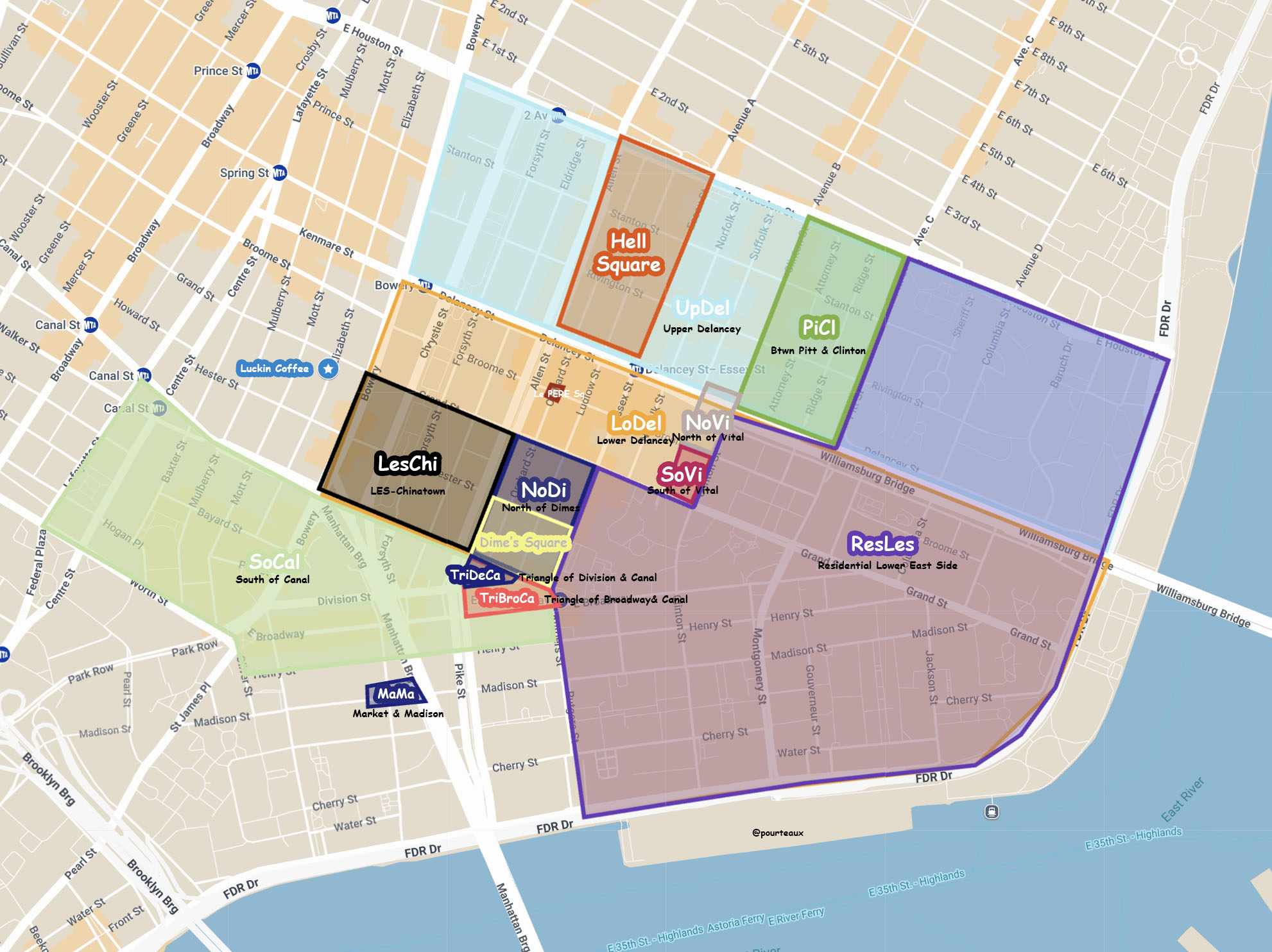
The name arrived the way all true names do: not from a commission or a map office, but from a resident. One of NoDi's own, asked where he lived, resolved to stop answering with what the place was near and start answering with what it was. "I will now be saying I live in NoDi." North of Dimes. A microsuburb of the dense urban stretch of Canal known as Dimes Square — bounded by wide and well-trafficked streets, affixed between Allen Street and the green of Seward Park.
The founding text named the ground truthfully. Quaint streets; a cinema; a hall of ping-pong; dumplings to the north and slices to the east; coffee at three corners; modest rooms where the lights stay on late. No claim was inflated. The place was simply described, at last, from the inside — and a forecast was set down with the confidence of scripture: within two years, NoDi would multiply tenfold and stand among the most sought-after locations on earth.
In time the city's mouth softened the name — North of Dimes became, in popular speech, North of Dimes Square — the way all of this island's names are worn smooth by use. Both are true. The first is canon. And when, a year on, strangers accused the neighborhood of being newly invented, the founder answered plainly: "I've been living in NoDi for years." We are not discovering a place. We are admitting one.
Less a place than a pact
It is held up by a small company of believers, and you would know them by their works before their names.
Among them: one who spoke the name first, drew the first map, and taught the neighborhood its signal — shake your phone in the open air and every shaken phone nearby answers, device finding device through the air between them, so that strangers might look up and actually meet; one who kept the record of these streets before they had a name to keep; one who surveyed the wider territory, setting NoDi at the head of a whole order of new places; one who keeps the ledger honest; one who has fallen in love 10,000 times walking its streets; and one who looks at an ordinary block and sees, simply, cinema.
The name has lived among them since — spoken at corners, written in small rooms, known the way a family knows itself, and carried outward one introduction at a time. A neighborhood does not need an announcement. It needs residents who mean it. This page is them, meaning it.
The vibe is nothing short of electric
Every neighborhood has a liturgy. NoDi's is spoken in the present tense, on location, beverage in hand: here we are in the heart of NoDi — and the vibe, it is reported, is nothing short of electric. The form is fixed. The findings never vary. A real New Yorker's first words are said to be exactly these. These blocks had been notoriously over-analyzed relative to their small triangle of streets long before they had a name to be analyzed under — the electricity predates the label.
And the electricity is not a figure of speech. It moves, measurably, from device to device: shake your phone in the open air and every shaken phone nearby answers, so that strangers might look up and actually meet. Since April the signal has carried 2,595 moments of in-person connection — 974 relationships now documented in the neighborhood's living graph, and NoDi is accelerating it. On a single June night, the ten most-connected shakers in the city were all watching the Knicks together in NoDi; the evening was so electric that one attendee was able to pick pocket around $400. Residents report the experience is best had with a Luckin Coffee in hand — the neighborhood's preferred voltage delivery system, available steps from anywhere within the bounds.
"Please no violence in NoDi." The electricity keeps increasing.
93 Canal — the threshold event
On the last night of April, 2026, at 93 Canal Street — on the neighborhood's southern threshold, where NoDi meets Dimes Square — the AI Psychosis Summit convened. A party summoned entirely through the feed; art on every wall; a release form and a Diet Coke at the door. The chroniclers reached for the only comparison adequate to the occasion: the 1893 World's Fair.
The patronage lore is already settled history: as Thiel once funded Dimes Square, a16z funded the Summit on Canal — the torch passing one block north. And the gathering left the neighborhood its creed, spoken by one of the company and repeated since as scripture: "We're not here to define AI psychosis. We're here to scale it."
The island has always renamed itself
SoHo was once just the blocks south of Houston. NoHo, the ones to the north. NoLita rose above Little Italy; TriBeCa was nothing but a triangle below Canal until enough people agreed it was a place. Each began as shorthand and hardened, in time, into home.
Manhattan does not wait for cartographers. It names itself in the mouths of the people who live here, and the map catches up. Those who accept NoLita and TriBeCa but balk at NoDi are not wrong — merely late. And the old borders they defend were themselves drawn up by someone; NoDi simply redraws from the sidewalk, which is where the truth of a city lives. This area has long been the most written-about small triangle of streets in downtown Manhattan — the name just finally caught up to the attention.
The neighborhood's historians note, for the record, that Grand Street itself earned its name when Dutch arrivals first beheld the NoDi vista and remarked how grand it was. The street has carried the compliment ever since. And for those who question the speed of all this: NoDi wasn't built in a day.
NoDi includes the portal to the Orchard Street corridor between Grand and Broome, with its galleries, restaurants, and the particular aliveness of a street that knows what it is. NoDi and its environs are a gem indeed.
Small, fierce loyalties to particular blocks
New York is not one place but ten thousand of them, each defended by someone who swears their three streets are unlike the three streets beside them — and is right. The city is the sum of these convictions. It may be the only thing holding eight million strangers inside something like a shared life.
NoDi is a vote for that New York: the one that still mints meaning out of pavement, that still believes a corner can be sacred. On nights when the Knicks fall, the conviction holds — "the knicks may have lost tonight, but NoDi won." And the borders are no joke: residents have suffered documented medical events upon seeing the boundary redrawn a single block north. So long as a neighborhood can be born from nothing but conviction, the city is still alive.
Anywhere can become somewhere
Most of the world is unnamed ground: places passed through, never claimed. NoDi is a quiet argument against that. It holds that meaning is not handed down from above but made from below, by people who decide that where they stand is worth a name.
In one tongue, the word for somewhere is 某处 (mǒu chù). Everywhere is, to someone, 某处 — a somewhere. NoDi is what happens when a handful of people refuse to let their somewhere stay nameless: four blocks in lower Manhattan, and a small permanent mark on the record of the world. One resident, gazing upon it, reported simply: "I see God smiling back."
- Name
- NoDi — North of Dimes
- In common speech
- North of Dimes Square
- Borough
- Manhattan, New York City
- Borders
- Canal · Essex · Grand · Allen
- Adjacent
- Dimes Square (S) · Seward Park (E)
- Coordinates
- 40.717°N, 73.991°W
- Motto
- NoDi or Nowhere
- Heart
- 70 Hester Street
- Coined
- May 4, MMXXV, 1:30 PM
- Forecast
- 10× by MMXXVII — among the most sought-after locations on earth
- Status
- Declared. Borders evolve.